
 One of the distinctive privileges of people like us, working in consulting and training, is that we ourselves make use of similar services, albeit in a slightly more unconventional form. Something along the lines of „we asked 100 women“ or „if you tap it here, where will it crack“. We usually start with something trivial, only for the thinking to turn down some woodland path within the very first minute.
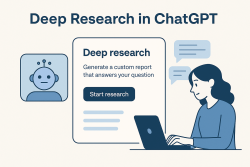
If you have not used the Deep Research option yet, give it a try. It will take you beyond the long and often rather scattered dialogues with ChatGPT.
As the literal translation suggests, „Deep Research“ is a capability for in-depth online research. Through this functionality, more detailed information from public sources is explored in a targeted way.
For example, SEO practices in the cosmetics trade, successful competitor examples, or ideas for the structure and content of pages using specific templates. Based on this information, a strategy and action plan can be developed, grounded in real market data rather than theory alone.
To learn more, we turned to the language model itself with the following prompt:
How exactly do I activate Deep Research?
Do I need to use ChatGPT-4.5 for Deep Research?
What are the advantages of 4.5 compared with other versions?
How exactly should I assign tasks to you in order to make full use of Deep Research?
In just 12 minutes, after reviewing 5 sources and running 18 searches, we received roughly the following answers, which we consider accurate:
Do you need GPT-4.5 for Deep Research?
No, ChatGPT-4.5 is not mandatory for Deep Research. Deep Research is a dedicated ChatGPT mode, available even to free and Plus users, although with a limited number of tasks (at the time of writing – 25). This means that any user can access Deep Research (subject to certain monthly limits) without necessarily having the GPT-4.5 model. That said, having a newer model such as GPT-4.5 may improve both the experience and the results.Advantages of GPT-4.5 in Deep Research
ChatGPT-4.5 offers several improvements over earlier versions that support the execution of Deep Research tasks. Some of these may not be immediately noticeable in practice, as overall speed is ultimately limited by the slowest point in the chain.Higher speed and efficiency: GPT-4.5 is optimised for smoother and more natural interactions. In complex research scenarios, this means faster processing of large volumes of information and more efficient source summarisation. Although Deep Research tasks still take several minutes, the more advanced model helps move through multiple steps more quickly, saving time compared with older models.
Greater depth of analysis: GPT-4.5 can process more context and demonstrates stronger capabilities for complex reasoning. This allows the Deep Research agent to go deeper into the subject matter and provide more comprehensive and coherent reports. With its improved cognitive “working memory”, the model can follow long chains of information without losing track, resulting in more in-depth analysis than earlier versions.
Broader search coverage: Thanks to its improved language capability and multilingual performance, GPT-4.5 can handle a larger volume of sources across different domains and languages. In Deep Research mode, this means the model can search across multiple sources in parallel and consolidate them into a single answer. The result is a richer set of data and perspectives gathered in one place, which increases the reliability of the final output.
How to formulate tasks for Deep Research
To activate Deep Research properly and effectively, formulate your request clearly and in detail. Specify exactly what you are looking for and what type of result you expect. A few practical guidelines:Be specific: Instead of asking a broad question, describe the exact issue or topic you want researched, and mention any special requirements you may have (for example, a specific time period or comparison criteria).
Use directive phrasing: Start the request with phrases such as „Research...“, „Investigate...“, or „Conduct an analysis of...“, so that it is clear you want an in-depth report rather than a short answer.
Add context where needed: If the question is complex, you can provide background information, attached files or examples in order to guide the model.
Examples of well-formulated tasks:
„Research the latest methods for treating type 2 diabetes and produce a detailed report outlining the advantages and disadvantages of each, supported by sources.“
„Investigate the electric vehicle market in Europe – compare sales by country over the past five years and present the data with charts and cited sources.“
„Carry out an in-depth analysis of the impact of social media on adolescent mental health, using scientific publications and statistical data.“
By formulating tasks in this way, you activate Deep Research mode successfully.
The model will understand that you expect a detailed, multi-step analysis, and it will make full use of the capabilities of ChatGPT-4.5 (if available) in order to deliver a comprehensive, evidence-based response.